
Buying a new machine creates capacity on paper.
Getting that machine to produce good parts, at the expected rate, with a repeatable process is an engineering problem.
That distinction matters as manufacturers continue adding and modernizing production capacity. U.S. manufacturing construction spending was running at an annualized rate of roughly $170.7 billion in August 2026. The pace has come down from previous highs, but manufacturers are still operating within a period of significant investment in industrial capacity.
Buildings, production lines, machine tools, automation, and equipment create potential capacity. They do not automatically create output.
Between investment and production sits a layer that is easier to overlook: engineering readiness.

Installed Capacity and Production-Ready Capacity Are Different
Consider the arrival of a new machining center.
The machine may be installed, commissioned, connected to utilities, and technically capable of producing hundreds of parts per shift.
But can production actually begin?
That depends on questions such as:
- Is the product design mature enough for production?
- Are manufacturing drawings and specifications correct?
- Has the process been defined?
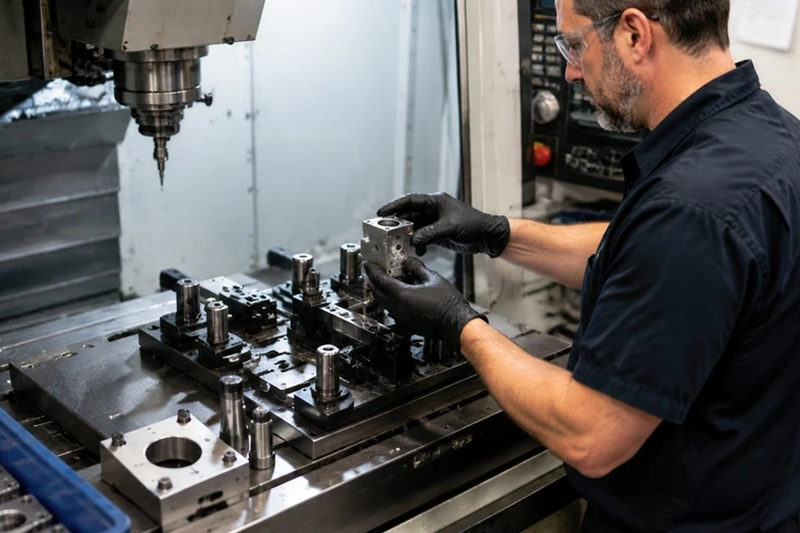
- Is the workholding ready?
- Can parts be located and clamped repeatably?
- Have loads and critical components been validated?
- Can operators safely load and unload the equipment?
- Is inspection tooling available?
- Can material move efficiently between operations?
- Has the process been tested under realistic conditions?
- Are engineering resources available when something does not work as expected?
A “yes” to the equipment purchase and a “no” to several of these questions is not production readiness.
It is unused capacity.
Engineering Readiness Is the Bridge Between Investment and Output
Production readiness is rarely controlled by one engineering discipline.
A new product or process can require mechanical design, manufacturing engineering, tooling, analysis, testing, material handling, controls, documentation, and shop-floor problem solving before the process becomes stable.
The work might include designing a fixture that reliably locates a component. It might involve finite element analysis to determine whether a structure can handle its expected loads. In another operation, the bottleneck might be an awkward material-handling step that prevents operators from keeping pace with the machine.
The important point is that these are not separate engineering inconveniences.
They are part of the same system that determines whether available manufacturing capacity can actually be used.
Tooling and Fixtures Turn Equipment Capability Into Repeatability
A production machine can repeat its programmed motion accurately. That does not mean the overall manufacturing process is repeatable.
The part also has to arrive in the correct location and orientation.
That is where custom tooling and fixtures become part of the capacity equation. Automation depends on predictable inputs. A robot cannot consistently load a part that cannot be located consistently, and inspection becomes more difficult when components shift during handling.
Good workholding controls the physical variables around the process. Depending on the operation, a fixture may need to:
- Establish repeatable datums
- Control part orientation
- Resist machining or assembly loads
- Prevent unwanted movement
- Provide operator access
- Maintain critical tolerances
- Support inspection
- Reduce setup variation
- Allow efficient loading and unloading
- Accommodate product variations
For engineers working through those issues, ENSER also has more detailed guidance on jigs and fixtures for production, including the relationship among accuracy, repeatability, workholding, and production workflow.
Before trying to extract more output from a machine, it is worth asking whether the process around the machine is repeatable.
Design Validation Helps Find Problems Before Production Finds Them
Production is an expensive place to discover a design problem.
When a component, fixture, support structure, or lifting device is subjected to loads that were not properly understood during design, the result can be excessive deflection, premature wear, poor alignment, structural problems, or an inability to perform the intended operation.
Analysis can move some of that discovery upstream.
Finite element analysis for tooling and fixtures, for example, allows engineers to evaluate how a design responds to expected loading conditions before fabrication. The usefulness of the analysis still depends on realistic loads, constraints, material properties, connections, and engineering assumptions.
FEA is not automatically the right tool for every problem. Sometimes traditional calculations, tolerance analysis, interference checks, prototypes, or physical testing provide the better answer.
The objective is not to simulate everything.
It is to resolve important engineering uncertainty before that uncertainty reaches production.
Material Handling Can Quietly Become the Bottleneck
A production process does not start when a machine cycle begins and end when it stops.
Parts have to reach the equipment. Operators or automation may need to lift, orient, locate, support, transfer, inspect, and remove them.
A machine capable of a short cycle time provides little advantage if handling the component between cycles takes much longer.
Material handling also becomes more difficult as parts become larger, heavier, irregularly shaped, delicate, or harder to reach. ENSER’s guidance on engineered material handling explains how those conditions can contribute to awkward operator movement, inconsistent placement, setup delays, bottlenecks, and product-handling risks.
This is why production-readiness reviews should look beyond the machine.
Ask how the part gets there.
Then ask how it leaves.
Testing Converts an Engineering Assumption Into Evidence
Every new manufacturing process begins with assumptions.
The fixture should be rigid enough. The lifting arrangement should control the load. The operator should be able to reach the work area. The support structure should remain stable. The machine should hold the expected tolerance.
Those statements may be reasonable during design. Before they become the basis of repeatable production, important assumptions need evidence.
Depending on the application, validation could involve:
- Dimensional inspection
- Load testing
- Functional testing
- Process trials
- Fit checks
- Cycle studies
- Prototype builds
- FEA correlated with physical results
- Operator evaluation
- Production-run validation
The appropriate validation depends on the consequence of being wrong.
The purpose is not testing for its own sake. It is removing uncertainty before uncertainty starts consuming production time.
More Equipment Can Increase the Demand for Engineering
There is a counterintuitive problem with capacity expansion.
Adding manufacturing equipment can increase the demand placed on engineering before it reduces the pressure on operations.
A production expansion may create simultaneous demand for:
- Equipment layouts
- Product changes
- Tooling and fixtures
- Structural supports
- Automation interfaces
- Work instructions
- Testing
- Material handling
- Design changes
- Supplier coordination
- Installation support
- Troubleshooting
- Production-launch support
That workload often arrives while the internal engineering team is still supporting existing products and daily production.
The constraint therefore moves.
The company may no longer be limited primarily by machines or floor space. The limiting resource can become the engineering bandwidth required to make the new capacity usable.
For manufacturers, that makes engineering capacity part of capacity planning.
A Practical Manufacturing Readiness Review
Before calling new production capacity ready, it helps to review the entire system.
Product
- Are drawings and specifications released?
- Are critical tolerances understood?
- Have manufacturability issues been resolved?
- Are likely failure points understood?
Process
- Is the production sequence defined?
- Are machine capabilities matched to the requirements?
- Have cycle assumptions been tested?
- Are handoffs between processes practical?
Tooling and Fixtures
- Is all required tooling available?
- Can parts be located and held repeatably?
- Have fixture loads and deflections been evaluated?
- Is operator access reasonable?
- Is the tooling practical to maintain?
Analysis and Validation
- Have critical loads and structural conditions been evaluated?
- Have important design assumptions been verified?
- Is FEA required?
- Is physical testing required?
- Are acceptance criteria defined before testing begins?
Material Handling
- How does material arrive?
- How is it lifted, rotated, transported, or positioned?
- Can operators perform those steps consistently?
- Does handling keep pace with production?
- Are storage and staging part of the process plan?
People
- Does the engineering team have enough capacity to support launch?
- Is specialized expertise available when needed?
- Who owns production problems during ramp-up?
- Can design changes be evaluated without delaying launch?
If several of those answers are still uncertain, the equipment may be installed, but the operation is not fully production-ready.
Think About Engineering Capacity Before It Becomes the Constraint
The best time to discover an engineering-capacity problem is not two weeks before a production launch.
Companies planning new facilities, equipment, product introductions, or production increases should evaluate engineering workload alongside machine capacity and staffing.
That does not necessarily mean permanently adding specialists for every possible need.
External engineering support can be used selectively where the workload or technical requirement exceeds available internal resources. A manufacturer might retain product ownership internally while bringing in additional capacity for FEA, tooling and fixture development, lifting devices, test equipment, mechanical design, or production-support projects.
The useful question is not simply:
Do we have enough engineers?
It is:
Do we have the right engineering capacity available at the points where the production plan depends on it?
Engineering Readiness Determines How Much Capacity You Can Actually Use
Capital equipment creates possibilities.
Engineering turns those possibilities into a process.
A production system needs parts that can be manufactured, tooling that controls them, equipment that can support expected loads, methods to move them safely, tests that validate important assumptions, and people who can resolve the problems that appear during implementation.
When those pieces are ready, new manufacturing capacity has a path to repeatable output.
When they are not, the machine may be waiting for engineering instead of making parts.
Frequently Asked Questions
What is manufacturing engineering readiness?
Manufacturing engineering readiness is the state in which the product design, production process, tooling, analysis, testing, material handling, documentation, and technical resources are prepared to support repeatable production.
Why does new manufacturing equipment fail to create immediate output?
Equipment provides potential capacity, but production also depends on released designs, stable processes, suitable workholding, validated loads, inspection methods, material flow, trained personnel, and engineering support during ramp-up.
How do tooling and fixtures affect production readiness?
Tooling and fixtures control part location, orientation, support, clamping, access, and repeatability. Poor or incomplete workholding can limit quality and throughput even when the production machine itself is capable.
When should FEA be used during production planning?
FEA can be useful when engineers need to evaluate stress, deflection, stability, fatigue, contact, or other structural behavior before fabrication. Traditional calculations or physical testing may be better for some questions, so the method should fit the decision.
How can outside engineering support help a capacity expansion?
Outside engineering support can add focused capacity for mechanical design, FEA, tooling and fixtures, lifting and material handling, test equipment, validation, and production-launch work when internal teams are supporting existing operations.