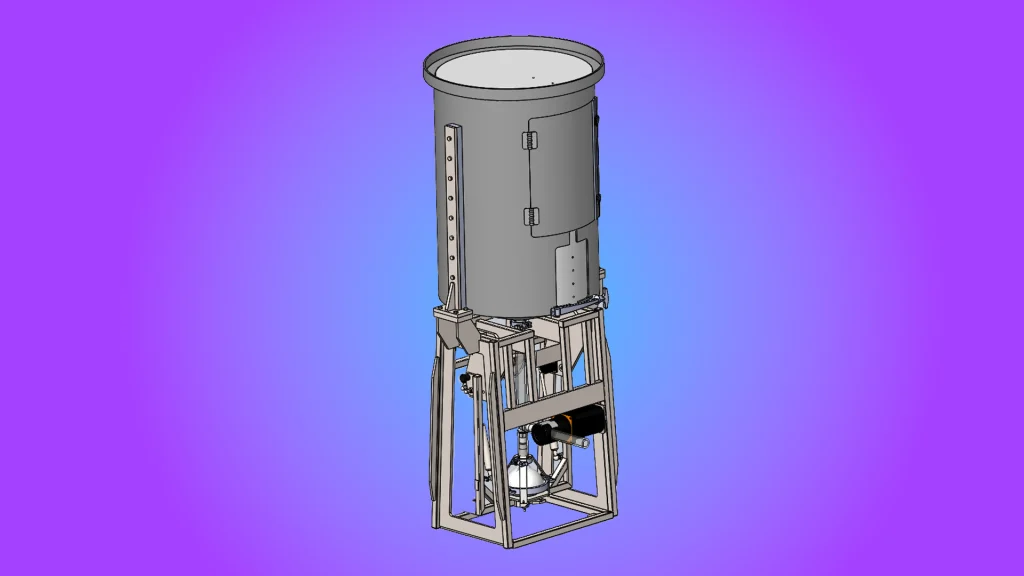
A specialty metals manufacturer needed a larger grinding arbor and support stand for an operation involving stacked knife disks. Existing equipment provided a proven starting point, but simply scaling up the previous design would also have carried its fabrication complexity into the new stand.
The challenge was straightforward: support the larger components and cantilevered loads while finding a simpler way to fabricate the stand.
The Engineering Challenge
The manufacturer’s existing grinding arbor stands were designed for smaller knife products. Their construction relied on large side plates and cross-plate elements that required substantial welding.
For the larger application, ENSER needed to determine which aspects of the existing equipment were worth retaining and which could be redesigned around a simpler structural load path.
Could the new stand handle the required loads while reducing fabrication-intensive plate construction and welding?
Answering that question required more than making the previous design larger. The structure had to account for the cantilevered arbor and the changing load conditions created as knife disks were added.
Designing Around the Actual Load Path
ENSER reviewed the existing units as a reference, then focused the redesign on how loads traveled through the structure.
The earlier stands relied heavily on large fabricated plates. ENSER instead developed a concept built around a main vertical round tube supporting the yoke that accepts the arbor flange.
Replacing several large plate elements with a primary tubular member simplified the structure and reduced the amount of fabrication-intensive welding. That change also made the connections between the yoke and tube particularly important.
ENSER used finite element analysis (FEA) to evaluate the structural behavior of the design, concentrating on the tangent welded connections where the yoke side plates meet the main tube. This allowed the engineering effort to focus on one of the areas most critical to the stand’s structural performance.
This reflects the broader practice of using engineering analysis to evaluate loads and design behavior before committing a design to fabrication.
Accounting for Changing Load Conditions
The stand could not be evaluated around a single static configuration. As knife disks are placed onto the arbor, both the total load and its center of gravity change.
ENSER considered the arbor in multiple loading conditions:
- Empty
- Partially loaded
- Fully loaded
The analysis therefore had to reflect how the stand would actually be loaded rather than relying on a simplified condition that represented only one point in the operating cycle.
Maintaining the Critical Arbor Fit
Structural capacity was only part of the problem. The relationship between the knife inside diameter and arbor outside diameter also had to be considered. These fit requirements informed the dimensional controls for the redesigned arbor.
Rather than unnecessarily changing a proven manufacturing approach, the new arbor retained an approach similar to existing arbors used for the manufacturer’s smaller knife products. That balance between redesign and reuse kept the project focused on the areas where a design change provided a practical benefit.
A Simpler Structure Without Ignoring the Loads

The resulting concept replaced the previous side- and cross-plate arrangement with a single vertical tube as the stand’s primary structural member.
The revised design:
- Supported the required range of cantilevered loading conditions.
- Reduced reliance on large fabricated plate elements.
- Concentrated structural analysis on critical welded connections.
- Accounted for changes in center of gravity as the arbor was loaded.
- Retained a familiar manufacturing approach for the arbor itself.
- Produced a structure identified in the project recap as more efficient to fabricate.
The project also illustrates why tooling and fixtures should be developed as part of the production system, not treated as an afterthought.
Engineering Takeaway
A better industrial equipment design does not automatically need to be more complicated.
In this case, simplifying the primary structure made the engineering questions more focused. Instead of carrying the fabrication complexity of the smaller stands into a larger design, ENSER concentrated its effort on the load path, welded connections, changing center of gravity, and dimensional fit.
For manufacturers evaluating a similar redesign, the lesson is simple: start with the loads and the manufacturing process, then determine how much structure is actually necessary.
This approach connects engineering decisions with practical manufacturing requirements rather than treating design and fabrication as separate problems.
Have equipment or tooling that has become unnecessarily difficult to fabricate? ENSER can help review the application, loads, connections, and manufacturing constraints before complexity is carried into the next design. Discuss your engineering needs with ENSER.
Technical Review by Mike Wahner
Senior FEA & Simulation Engineer
30+ years of engineering experience at ENSER
Related Articles and Case Studies
Frequently Asked Questions
What is a grinding arbor stand?
A grinding arbor stand supports an arbor used to hold components during a grinding-related manufacturing operation. Its design must account for the weight and position of the arbor and components, how those loads transfer into the supporting structure, and any changing load conditions that occur during use.
Why was finite element analysis used for the stand?
Finite element analysis allowed ENSER to evaluate how the redesigned structure responded to the required loads. Particular attention was given to the tangent welded connections between the yoke side plates and the main tube because those connections were important to the structural load path.
Why does the center of gravity matter in an arbor design?
A cantilevered arbor creates forces and moments at its supporting structure. As components are added, the total weight and location of that weight change. Evaluating empty, partially loaded, and fully loaded conditions helps engineers understand how the structure will behave throughout its intended loading range.
How can simplifying a welded structure improve fabrication?
Large plate structures can require numerous parts, welds, fit-up operations, and fabrication steps. In this project, replacing much of the previous side- and cross-plate arrangement with a primary vertical tube reduced fabrication complexity while retaining the required load-bearing function.
Can existing industrial equipment be used as the basis for a new design?
Yes. Existing equipment can provide useful information about geometry, interfaces, manufacturing methods, and features that have worked in service. Engineers can retain proven features while reevaluating parts of the structure that are difficult to fabricate or are no longer appropriate for the new loading conditions.