
Custom Material Handling Lift for Large Metal Panel Installation
Customer Challenge
A manufacturer of high-voltage grid components needed a safer and more efficient method for handling large metal panels used in cabinet assembly. The panels arrived stacked tightly on pallets without sufficient clearance between them, making it difficult to separate and lift a single panel.
The existing process required two employees to manually carry each panel, position it at the assembly, and hold it in place during installation. This created ergonomic and safety concerns, increased the risk of dropping or damaging the panel, and made the installation process unnecessarily time-consuming.
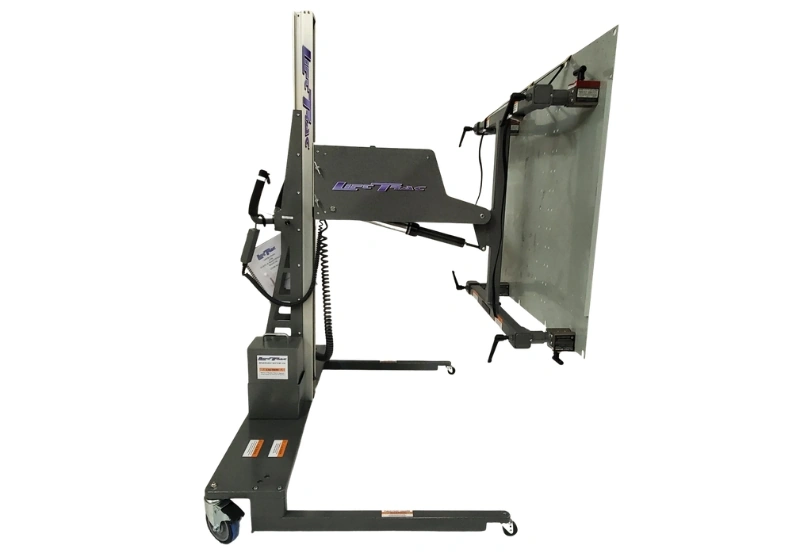
ENSER developed a customized LiftTrac LT250-48 material handling system with powered positioning and purpose-built panel-handling tooling. The resulting system allowed operators to lift one panel at a time, transport it securely, adjust its orientation, and position it for installation.
- Industry: Energy equipment manufacturing
- Application: High-voltage grid component cabinet assembly
- Engineering disciplines: Material handling, tooling and fixtures, mechanical design, testing
- Equipment platform: Customized LiftTrac LT250-48
- Project completed:July 2022
The Material Handling Challenge
The manufacturer’s metal cabinet panels presented several interrelated handling challenges:
- Panels were delivered in tightly stacked pallet loads with little or no clearance between individual sheets.
- The lift had to extract only the uppermost panel without attracting or disturbing the panels beneath it.
- Multiple panel dimensions had to be accommodated by a single lifting system.
- The panel surfaces could not be scratched, dented, or otherwise marred.
- Pallet geometry restricted the equipment’s approach to the load.
- Operators needed to transport the panels across the work area without losing control of the load.
- Each panel had to be tilted and accurately positioned during cabinet assembly.
- The lifting equipment had to provide sufficient reach while maintaining stability.
- The process needed to reduce dependence on two-person manual handling.
The engineering objective was therefore broader than simply lifting the panels. The system needed to support the complete handling cycle: picking, securing, transporting, orienting, and positioning the panel for installation.
Engineering Objectives
ENSER established several functional and safety requirements for the new lifting solution.
The system needed to:- Lift a single panel from a tightly stacked pallet.
- Prevent magnetic force from affecting the panels below the selected panel.
- Accommodate multiple panel sizes.
- Protect finished panel surfaces from damage.
- Maintain load stability during travel.
- Tilt and pitch the panel into its installation orientation.
- Reach the assembly location without obstructing the operator.
- Navigate the pallet and surrounding floor-space constraints.
- Reduce manual lifting and handling by employees.
- Demonstrate safe performance through physical testing.
ENSER’s Engineering Approach
Application and Process Review
ENSER began with a fact-finding process involving the equipment dealer and the end user. The engineering team reviewed operating dimensions, panel configurations, installation requirements, photographs, and videos of the existing manual process.
This application review helped define the complete range of motion, equipment approach, load-control requirements, and operator interaction needed for the system.
Magnetic Lifting Evaluation
Because the panels arrived in direct contact with one another, magnet selection was a critical engineering consideration.
ENSER evaluated magnetic strength to identify a solution capable of:
- Reliably gripping the selected panel
- Providing adequate resistance to shear forces during lifting and travel
- Avoiding magnetic “bleed-through” to the panel beneath it
- Protecting the panel’s finished surface
Representative panels were sent to ENSER for in-house evaluation and testing. This allowed the team to validate the lifting concept using actual production parts rather than relying solely on theoretical specifications.
Concept Development and CAD Design
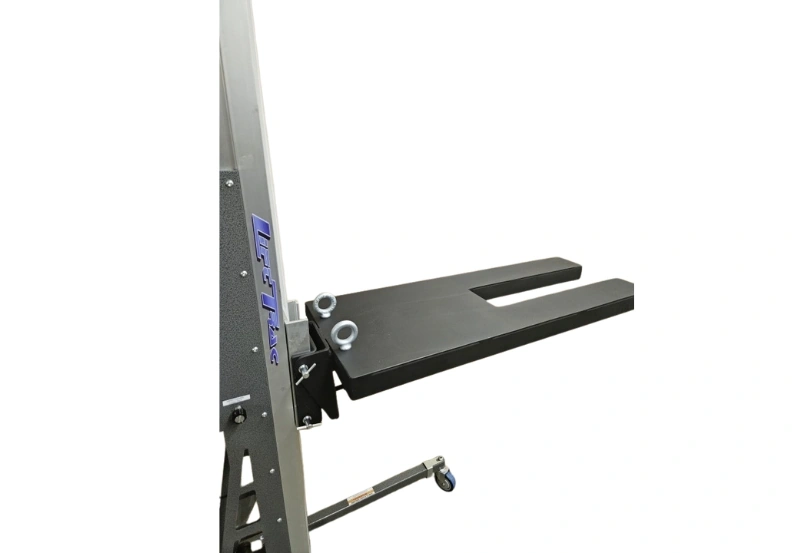
After reviewing the application, ENSER developed a lifting concept based on the LiftTrac LT250-48 portable lifter-transporter.
A 3D SOLIDWORKS model was prepared to communicate the proposed configuration and allow the dealer and end user to review:
- Overall equipment geometry
- Base dimensions
- Leg configuration
- Panel-lifter dimensions
- Operator clearance
- Positioning range
- Interface between the lift and custom end-effector
The design was revised through the customer-review process before final approval and fabrication.
The Custom-Engineered Solution
ENSER modified both the LiftTrac base equipment and its panel-handling attachment to meet the application requirements.
Customized Lift Base
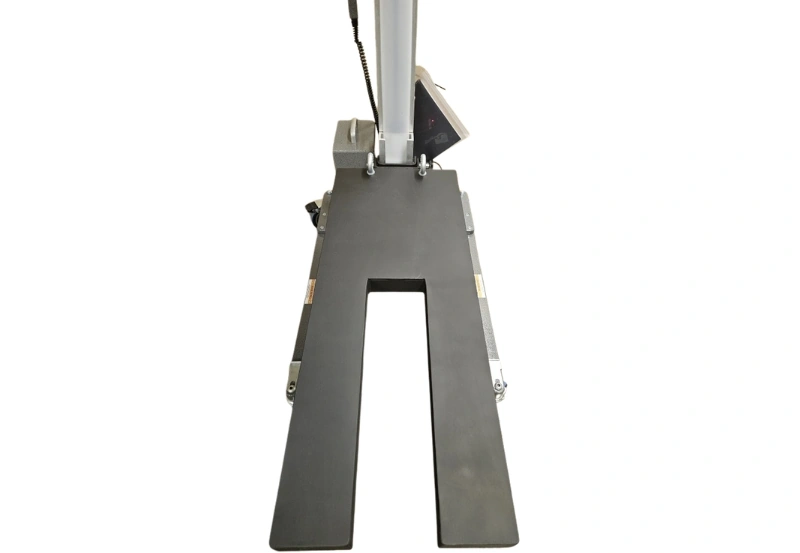
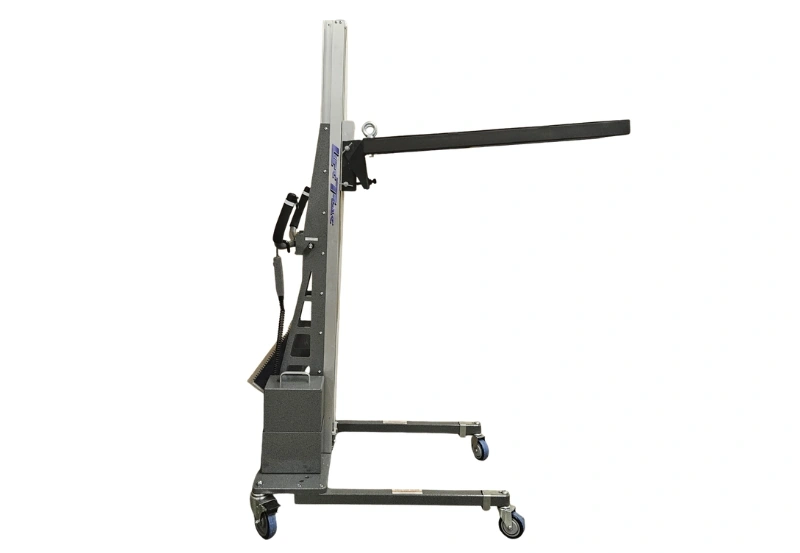
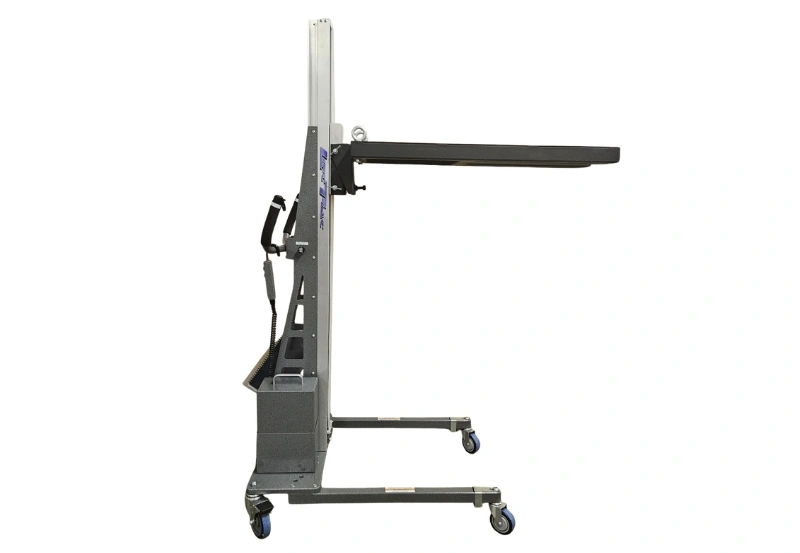
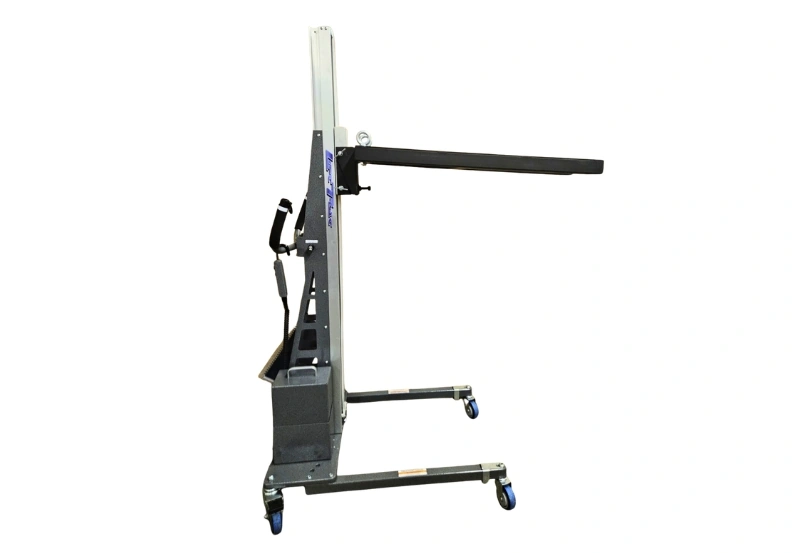
The lift base was widened to improve stability while supporting the panel away from the vertical mast.
Additional base modifications included:
- Low-profile legs to improve access beneath and around the pallet
- Extended front legs to support the required load position and reach
- Fully swiveling casters in place of standard directional wheels
- A heavy-duty base configuration tailored to the operating environment
These changes allowed the system to approach the pallet more effectively while giving the operator greater maneuverability within the production area.
Powered Pitch and Panel Positioning
The system incorporated a powered pitch mechanism based on LiftTrac’s eccentric-roll manipulator design.
This mechanism allowed the operator to:
- Lift the panel in a controlled orientation
- Transport it through the work area
- Tilt or pitch it forward
- Present it at the angle required for cabinet assembly
- Hold it in position while installation was completed
The powered positioning capability eliminated the need for employees to manually support and rotate the panel during installation.
Adjustable Magnetic Panel Lifter
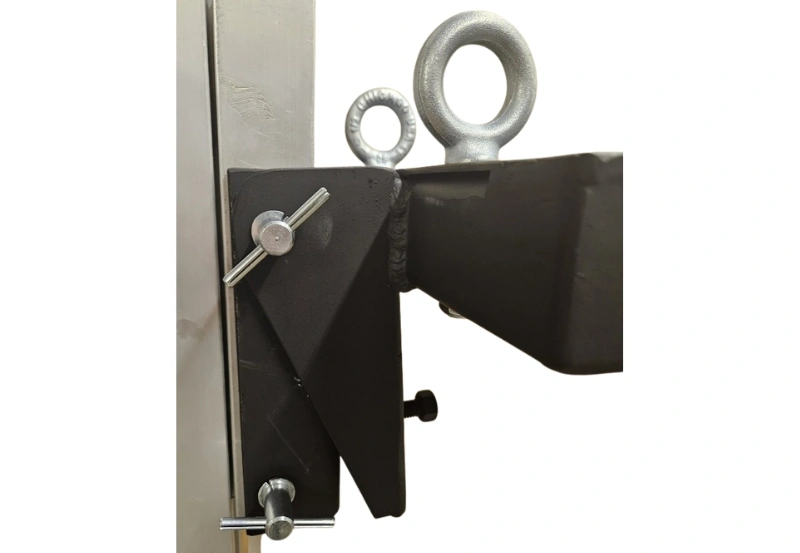
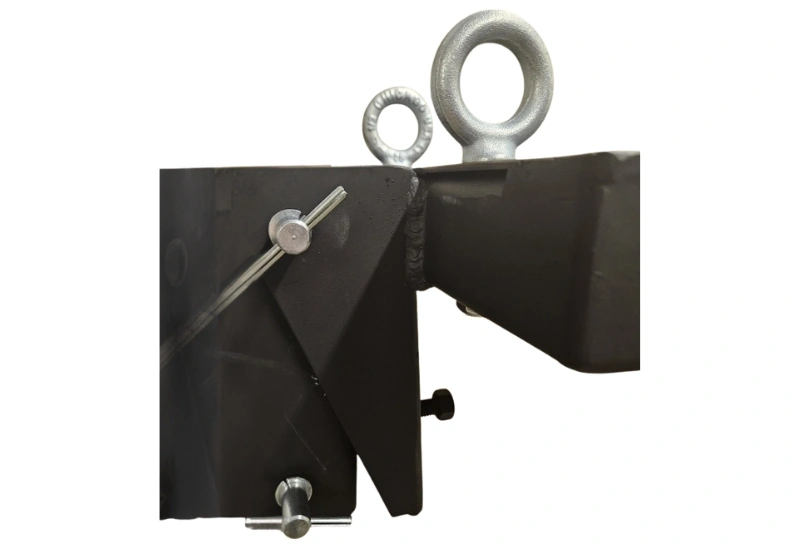
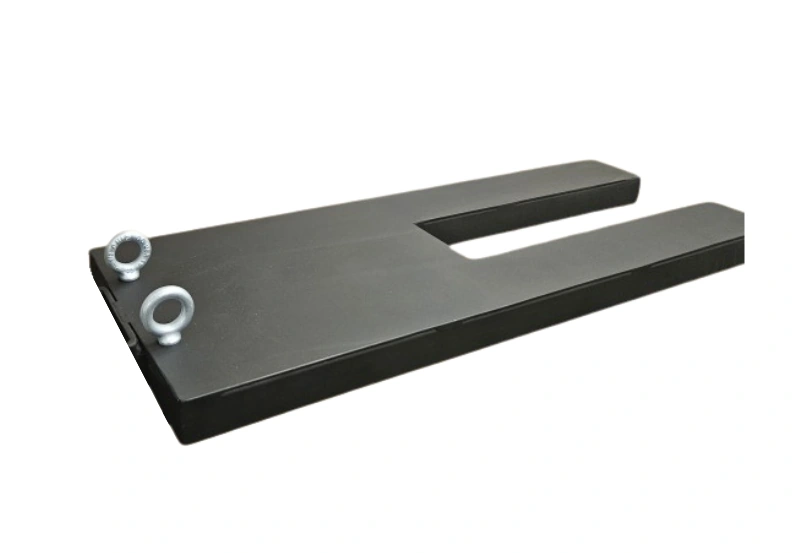
ENSER designed a custom panel-lifting end-effector with adjustable arms to accommodate the manufacturer’s different panel sizes.
The tooling incorporated non-marring magnetic contact points selected for the specific material and handling conditions. The adjustable configuration allowed one lifting device to be used across a broader family of panel geometries rather than requiring separate tooling for each part.
Redundant Load-Control Features
Additional mechanical safeguards were included to improve panel stability during transport and positioning.
These features included:
- A retaining lip across the lower magnetic contact area
- Adjustable support geometry
- Securing straps to restrain the panel during movement
- Controlled powered tilting
- Physical load and operational testing
Together, these features provided multiple layers of load control rather than relying solely on magnetic attraction.
Testing and Validation
ENSER performed in-house testing using customer-supplied panels during the manufacturing process.
Testing addressed:
- Single-panel separation from a stacked pallet
- Magnetic holding performance
- Resistance to panel movement during transport
- Compatibility with multiple panel sizes
- Equipment stability
- Powered pitch and positioning operation
- Operator access and usability
- Protection of the panel’s finished surfaces
Load and safety testing were completed before the equipment was released for production use.
Project Outcome
The completed LiftTrac system gave the manufacturer a dedicated solution for handling large grid-component cabinet panels throughout the lifting and assembly process.
The custom equipment enabled operators to:
- Remove one panel at a time from a tightly stacked pallet
- Secure the panel without damaging its surface
- Move the panel through the facility with controlled support
- Adjust its orientation using powered pitch
- Position and hold the panel during cabinet installation
- Reduce the need for two-person manual handling
The system addressed both the immediate safety concern and the broader productivity limitations of the previous process.
The customer subsequently identified another application for the equipment and ordered an additional lifting bar for the panel-handling attachment. That expansion demonstrated that the modular lifting platform could be adapted to support more than the original operation.
Engineering Results at a Glance
| Requirement | Engineered Response |
|---|---|
| Lift one panel from a tight stack | Application-specific magnetic selection and testing |
| Avoid lifting panels underneath | Magnet evaluation using customer-supplied panels |
| Prevent surface damage | Non-marring magnetic contact points |
| Handle multiple panel sizes | Adjustable panel-lifter arms |
| Improve pallet access | Low-profile, extended base legs |
| Maintain equipment stability | Widened heavy-duty base |
| Improve maneuverability | Fully swiveling casters |
| Secure the load during travel | Lower retaining lip and safety straps |
| Position panels for assembly | Powered pitch mechanism |
| Validate safe operation | In-house load and functional testing |
Custom Material Handling Engineering from ENSER
Standard lifting equipment is not always suited to specialized production parts, restricted pallet access, delicate surfaces, or complex installation requirements.
ENSER designs and manufactures custom material handling systems, tooling, fixtures, end-effectors, and lifting equipment for applications that require more than an off-the-shelf product. Our engineering process can include application analysis, concept development, mechanical design, 3D CAD modeling, prototyping, fabrication, testing, and production implementation.
Need a safer way to lift, transport, rotate, or position a difficult component?
Contact ENSER to discuss a custom material handling or LiftTrac application.
FAQ
Automate for Consistency and Precision
Transform your manual process with ENSER's Engineering Services. We deliver automation systems that enhance accuracy and product quality.