
Moving heavy loads is one of the most common challenges in industrial manufacturing. Parts need to be lifted, rotated, positioned, transferred, staged, inspected, and assembled without damaging the product or putting operators at unnecessary risk.
For many companies, material handling problems are treated as workflow issues or safety concerns. Those labels are accurate, but they do not tell the whole story. In many cases, the root problem is an engineering problem.
A part may be too heavy to move manually. The center of gravity may be difficult to control. A fixture may not support the component in the right position. Operators may need to reach, bend, twist, or guide a load through a difficult movement. Over time, these conditions can affect safety, productivity, quality, and morale.
That is why engineered material handling is becoming more important for manufacturers that want safer and more reliable production processes.
Material Handling Is More Than Moving Parts
Material handling is often viewed as the movement of parts from one location to another. In practice, it includes every step required to lift, support, transport, position, and protect a part throughout production.
When that process is not engineered well, manufacturers may experience:
- Manual lifting risks
- Awkward operator positions
- Inconsistent part placement
- Damage during transport
- Slow setup or changeover
- Production bottlenecks
- Increased rework or scrap
- Higher risk during lifting or rotation
These issues are especially common with large, heavy, irregular, fragile, or high-value components. A standard cart, hoist, or lift device may not be enough when the load shape, center of gravity, access points, or production sequence requires a custom solution.
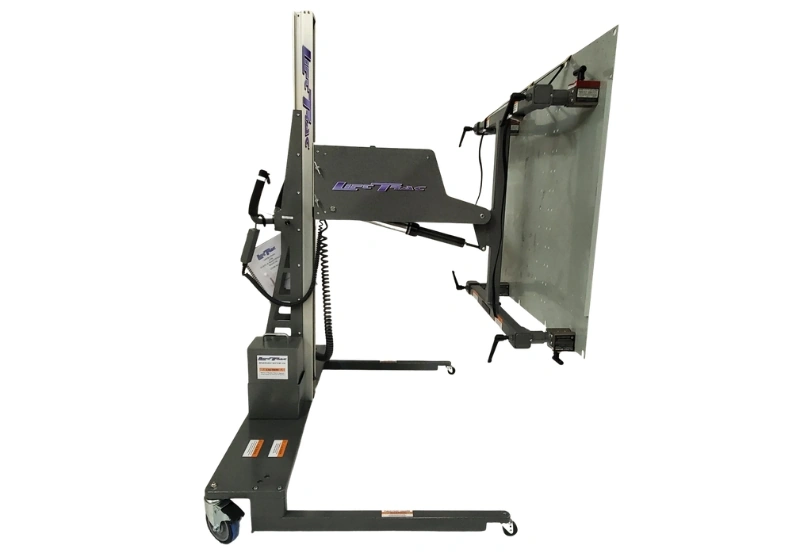
In some applications, the right solution may be a custom-engineered handling system, while in others a proven lift-and-transport platform may help address the problem more quickly. ENSER’s LiftTrac lifter transporters are designed to help manufacturers lift, move, and position heavy or awkward loads more safely and efficiently, supporting better material flow while reducing unnecessary strain on operators.
Ergonomic Risk Is an Engineering Concern
Ergonomics is often discussed as a safety program, but many ergonomic risks are created by the physical design of the process. If operators must repeatedly lift a heavy part, reach into a fixture, guide a suspended load, or reposition a component by hand, training alone may not solve the problem.
Better engineering can reduce the source of the risk.
Custom lifting devices, lift-assist equipment, positioning fixtures, carts, turn-over tools, and workholding systems can help reduce physical strain while improving process control. These solutions support safer movement, better access, and more consistent handling.
For manufacturers, that can mean fewer manual handling issues, less wasted motion, better part protection, and a more repeatable process.
Why Custom Lifting Devices Matter
Not every load can be handled with standard equipment. Some parts need to be lifted from specific points. Others need to be rotated, tilted, balanced, or positioned with tight control. In these cases, a custom engineered device may be required.
Below-the-hook lifting devices are a common example. These devices connect the crane or hoist to the load and are designed around the specific part, lifting points, center of gravity, and handling requirements.
ENSER supports manufacturers with below-the-hook lifting devices that are engineered for safety, efficiency, and application-specific use. These projects often require a clear understanding of the load case, structural behavior, operator access, and how the device will be used in the real production environment.
Engineering Validation Helps Reduce Handling Risk
When a lifting device, fixture, cart, or support frame is used around operators and valuable equipment, validation matters. A design needs to do more than look correct. It needs to perform safely under load.
Engineering analysis can help evaluate:
- Load paths
- Stress and deflection
- Safety factors
- Center of gravity concerns
- Fixture rigidity
- Material selection
- Welded frame behavior
- Potential failure points
Finite Element Analysis can be especially useful when manufacturers need to understand how a structure may behave before fabrication. ENSER’s finite element analysis services help customers evaluate designs before they become physical equipment.
This type of validation does not replace practical experience. It strengthens it. By combining analysis with manufacturing knowledge, engineers can reduce uncertainty and improve confidence before equipment is built and placed into service.
Safer Handling Can Improve Productivity
Material handling improvements are often justified through safety, but the benefits usually extend beyond risk reduction. When a part is easier to lift, move, align, or position, the process can become faster and more consistent.
A better handling system can help manufacturers:
- Reduce setup time
- Improve part flow between workstations
- Support repeatable positioning
- Reduce operator fatigue
- Protect parts from damage
- Improve access for assembly or inspection
- Support more consistent production output
In this way, ergonomic lifting solutions are not only safety investments. They are also production improvements.
Where ENSER Helps Manufacturers
ENSER helps manufacturers solve practical handling, lifting, and production challenges through engineering services, custom fixtures, below-the-hook lifting devices, material handling equipment, Finite Element Analysis, testing equipment, and manufacturing services.
The goal is to understand the complete application: what needs to be moved, how heavy it is, where it needs to go, how it will be supported, who will use the equipment, and what risks must be reduced.
That engineering-first approach helps customers move beyond temporary workarounds and develop safer, more reliable handling solutions.
Manufacturers can also review ENSER’s case studies to see examples of engineered fixtures, lifting devices, and production support projects. For additional technical topics, the ENSER blog includes articles on tooling, fixtures, FEA, lifting equipment, and manufacturing problem-solving.
The Bottom Line
Material handling and ergonomic risk should not be treated only as safety checklist items. They are often signs that a process needs better engineering.
When manufacturers use custom lifting devices, handling fixtures, carts, positioning equipment, and validated structures, they can improve safety while also supporting quality, throughput, and repeatability.
For companies moving heavy, awkward, or high-value components, engineered material handling can be one of the most practical ways to reduce risk and improve production performance.